
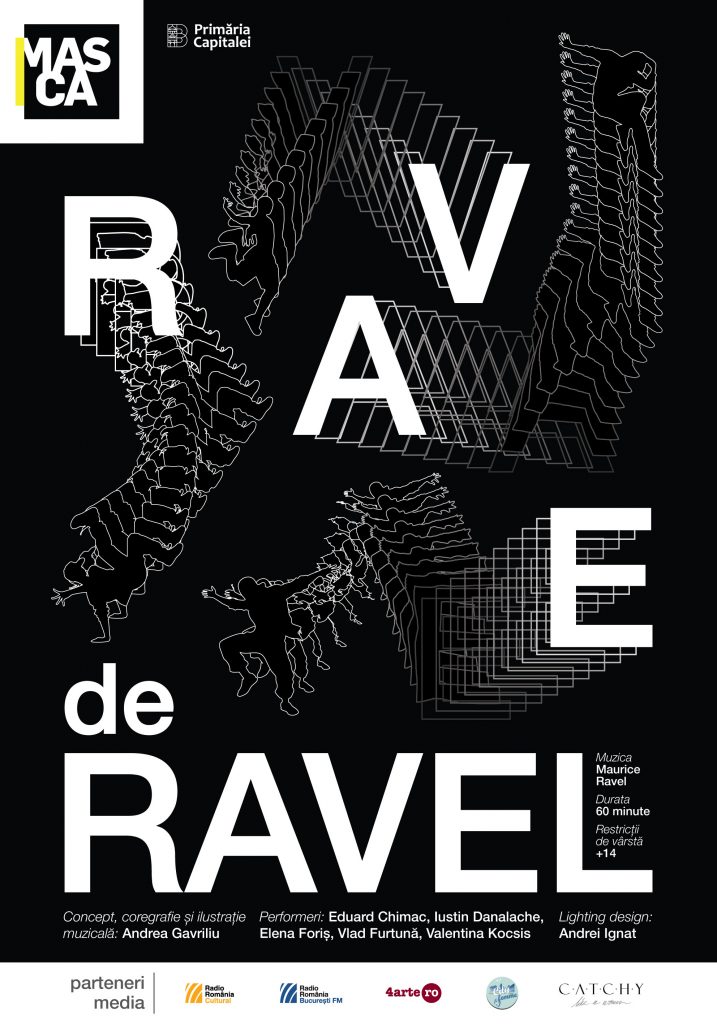
RAVE DE RAVEL
- a physical theater performance -
by Andrea Gavriliu
About the show
Rave by Ravel is a physical theater performance that explores the contrast between classic and contemporary, between the solemnity of Maurice Ravel’s music and the visceral energy of an urban body language, inspired by street dance and African tribal dance. Five young people, casually dressed, like a gang from a suburban neighborhood, engage in a dialogue with classical music not through opposition, but through a unique form of resonance – the groove. This term, originating from jazz, expresses the personal, organic way in which each body allows itself to be permeated by rhythm, finding its own cyclicality in movement.
Each choreographic sequence develops to a piece by Ravel, building relationships, tensions, and complicities among the group members: an attempt at seduction to Pavane pour une infante défunte, an almost telepathic fraternal bond to Jeux d’eau, a game of caricatural transformations to Alborada del Gracioso, or solo moments of “visualizing music” in a playful key to fragments from the opera L’enfant et les sortilèges.
The famous Boléro – a leitmotif of the show – becomes a contemporary tribal ritual, where the hypnotic repetition of the musical theme awakens the ancestral instinct of dance. The choreography, devoid of a classical dramaturgy, has a modular structure, emphasizing freedom of expression and the relational dynamics of a group of young people who reinvent a cultural heritage with freshness, humor, and impertinence. Rave de Ravel is not just a fusion of styles, but a statement about how classical music can pulse to the rhythm of the present.
The Creators
Concept, choreography, and musical illustration: Andrea Gavriliu
Lighting design: Andrei Ignat
Music: Maurice Ravel
Performers
Eduard Chimac
Iustin Danalache
Elena Foriș
Vlad Furtună
Valentina Kocsis
Andrea Gavriliu’s choreographic style is playful, unashamed, full of exaggerated gestures and comical pantomimes often juxtaposed here with dramatic, resounding music. We are introduced to the world of these young people who, beyond a tough facade, are actually going through betrayals, falling in love, losses, and games – they seek each other on stage in playful, sensitive, or melodramatic moments full of emotion. Multiple dance and movement styles are distinguishable: sequences of street dance, African tribal dance, contemporary dance, and classical ballet. It is worth noting that in Romania, Gavriliu is unsurpassed as the most prolific artist in the field of physical theater, and her technical rigor and fascination for the physicality of the performers are the foundation of her explosive shows.(…)
In a scene with Vlad Furtună, Eduard Chimac, and Iustin Danalache, the three play a terrible boyish game until one of them falls, seemingly dead, to the floor. The humor is created by the inexplicable gesture and the way the other two launch into a pantomime of despair, rapid, flamboyant, and exaggerated movements, to the laughter of the audience. Many moments read like silent film scenes or sequences from old school cartoons, with the performers impeccably playing the absurdity of jokes seemingly ripped from Looney Toons. old school cartoons, with the performers impeccably playing the absurdity of jokes seemingly ripped from Looney Toons.
A duet between Valentina Kocsis and Eduard Chimac begins with a flirtatious moment – she sits down and pulls herself, little by little, closer to him, with a touching awkwardness, then broken by humor. It then continues with a complex partnering sequence, a back-and-forth where they push, slap, approach, distance, tumble over each other and one after another. Something to admire in the choreographer’s work is that the sexual gestures in the on-stage relationships are never vulgar or ostentatious, but always playful, exaggerated, generating laughter and empathy from the audience (…) (Simina Popescu, Rave de Ravel)
Andrea Gavriliu’s newest physical theater craze, taken off the wish shelf and staged at Masca Theater (also) to Ravel’s Boléro. And especially beyond it. Or the most beautiful encounter of street girls and boys with the coolest classical sound, skillfully taming hearts and adolescent rebellions, called to unleash and indulge. By one of the most important choreographic artists in the local landscape.
Magical contrasts at every turn in the resonance box of one of our stage’s most skilled animators of bodies, transformed with grace and sensuality into play and games, super-vibes, super-emotion, much humor, and a lot of energy.
A masculine/feminine game on the theme of “sometimes she doesn’t want, sometimes she gives in! (…)”, without words, achieving a dramatic quality of the highest theatricality.
The rest is poetry and freedom.
With bows of lapels. Of rave. Of Ravel.
And the Boléro… Oh, the Boléro!… ( Luciana Antofi , Drama-groove or the corporal poetry of a boléro: RAVE DE RAVEL BY ANDREA)
Eduard Chimac, Iustin Danalache, Elena Foriș, Vlad Furtună and Valentina Kocsis occupy the stage and capture attention from the moment spectators enter the hall. Gradually, the story unfolds: unleashed passions, budding love stories, power games, understanding the universe – all these are explored in the show’s moments. A very intelligently conceived ad regressum journey by Andrea Gavriliu, because the show ends with a tribal dance, a moment when the spectator realizes they have just taken part in a highly condensed history of dance course, well hidden behind the dance movements of generically called street dance styles (…) ( Nona Rapotan, Rave de Ravel – The Right to Dream with Open Eyes)
“Rave de Ravel” is not just a fusion of styles, but a metaphor for the reunion of past and present, a dialogue between classical refinement and street energy. Art has no expiration date – it can be reinterpreted, adapted, and kept alive in contemporary society (…) ( Radu -Denisa Mihaela, Rave de Ravel” when classical dances to contemporary rhythms)


